Full-stack development, owned end to end
Splitting a system across a frontend vendor and a backend vendor moves the hardest problems into the gap between them. Full-stack means one team is accountable from the database index to the focus ring and nobody gets to call an integration failure somebody else's ticket.
What "full-stack" should mean
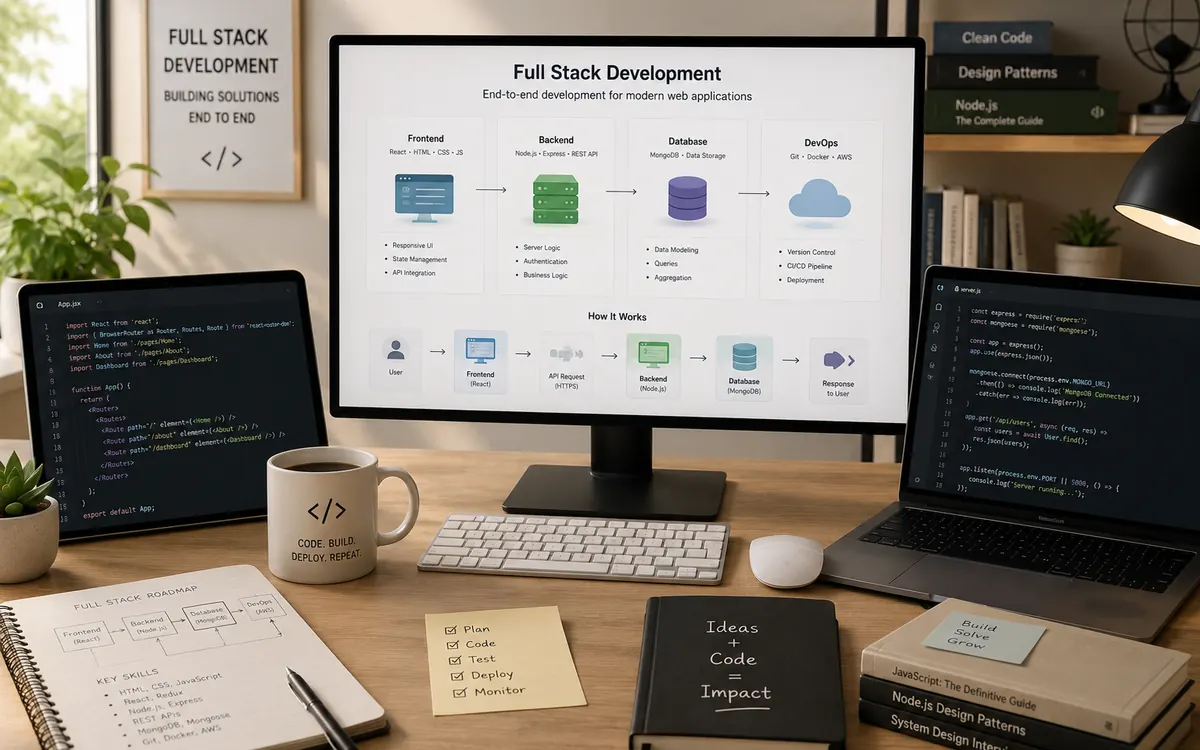
Full-stack development is building every layer a feature passes through: the interface, the client state, the API contract, the business logic, the data model, and the infrastructure it all runs on. It is not a claim to be equally expert at every layer it is a commitment that no layer is somebody else's problem.
The practical value is in the seams. Most defects in a working system live at boundaries: an API returning a shape the client did not expect, a timezone converted twice, a validation rule enforced in the form but not on the server, a cache nobody invalidated. When one team owns both sides of a boundary, those defects get designed out instead of discovered in production.
What we provide
Frontend
Component architecture, client state, routing, forms and validation, and the loading and error states that separate a demo from a product.
API design
Resource modelling, versioning, pagination, idempotency on anything that writes, and consistent error shapes so the client can handle failure without string matching.
Databases
Schema design against real access patterns, indexes chosen from query plans, and migrations that run in the pipeline rather than by hand.
Authentication and authorisation
Sign-in, sessions or tokens, refresh and revocation, and role or permission checks enforced server-side where they cannot be bypassed by a devtools console.
Cloud and CI/CD
Environments per branch, automated build and test on every pull request, deploys that are boring, and rollbacks that do not require a person to remember the previous version.
Monitoring
Uptime checks, error tracking with real stack traces, and enough logging to answer "what happened to this one user" without redeploying.
Who we do this for
Founders building a first product
One team that can take a feature from idea to production, rather than coordinating three specialists on a schedule none of them share.
Companies with a frontend and no backend (or the reverse)
Half a system is common. Completing it well means respecting what already exists rather than restarting.
Teams whose integration keeps slipping
When "it works locally" and "it works in staging" are different sentences, the fix is usually structural.
What this solves
The frontend and backend disagree
Contracts that live in a chat thread instead of in code. We define the shape once and validate against it on both sides, so a mismatch fails a build rather than a customer.
It works until it has real data
Queries with no index, lists with no pagination, and joins nobody profiled. All of these look fine on a seed database of forty rows.
Deploys are events
If shipping requires a calendar entry, the pipeline is the bug. Automated build, test and deploy makes releases small enough to be uninteresting.
Nobody knows when it breaks
Systems without monitoring are debugged by customers. Error tracking and uptime checks belong in the launch scope, not the next quarter.
How we work
- Step 01
Model the domain before the screens
What the entities are, how they relate, and which operations must be atomic. Getting this wrong is the one mistake a UI cannot paper over.
- Step 02
Define the contract
The API shape is agreed and typed before either side is built, so frontend and backend can proceed in parallel without inventing each other.
- Step 03
Ship a vertical slice
One feature working all the way through UI, API, database, deployed before the second starts. Integration risk surfaces in week one, not week nine.
- Step 04
Instrument before scaling
Monitoring and error tracking go in before load does, because the first scaling problem you meet is always the one you did not predict.
What we build with
Frontend
- React
- Vite
- TypeScript
- Tailwind CSS
Backend
- Node.js
- REST APIs
- Azure Functions
Data
- PostgreSQL
- SQL Server
- Document stores
Operations
- GitHub Actions
- Preview environments
- Error tracking
This list is what we actually work in, not a catalogue. Where a project needs something outside it, we will say so rather than learn it on your budget.
The parts nobody demos
Security, performance, deployment, testing and maintenance decide whether a project is still working in two years. They are scoped in from the start rather than quoted as extras.
Security
Server-side validation on every input, parameterised queries, secrets held by the platform, least-privilege service identities, dependency auditing in CI, and authorisation enforced at the API layer the client is a convenience, never a control.
Scalability
Stateless request handling so instances can be added freely, caching at the edge for anything that is not per-user, background jobs for work that must not block a response, and indexes chosen from measured query plans rather than guesses.
Testing
Unit tests on business logic, integration tests across the API boundary, and a full production build in CI on every pull request. The goal is not a coverage number; it is that a regression in the parts that would be expensive to break fails loudly.
Deployment
Every branch gets a preview environment, every merge deploys automatically, and every deploy can be rolled back. Database migrations run as part of the pipeline with a forward path defined before the change ships.
Monitoring
Uptime, error rates and Core Web Vitals from real users, plus structured logs with enough context to trace a single request end to end.
What people come to us with
- A first version of a product that has to be credible with real users, not a prototype
- A customer portal with sign-in, roles and per-account data
- An internal tool replacing a spreadsheet that has become load-bearing
- Adding a real backend to a frontend that has been running on mock data
- Taking over a half-finished build and getting it to production
Where we have done this
Builds where this capability carried real weight. Each case study describes what was actually engineered.


Full-Stack Development questions we get asked
Web development is often used for the site itself the pages a visitor sees. Full-stack is the wider commitment: the same team also owns the API, the data model and the deployment. A brochure site needs web development. Anything with accounts, saved state or integrations needs full-stack.
Yes. Schema design, indexing, migrations and the queries the application runs. On projects with an existing database we work with it rather than around it, and say plainly when a schema change is the cheaper option.
Frequently. It starts with an audit dependencies, build, tests, security posture, performance so you get an honest picture of what is worth keeping before anyone proposes a rewrite. Rewrites are usually the most expensive answer and rarely the necessary one.
By default we use a managed identity provider rather than storing passwords ourselves, because credential storage is a liability with no upside. Where a custom implementation is genuinely required, it uses modern password hashing, short-lived tokens and server-side revocation.
Thinking about full-stack development?
A short conversation is usually enough to tell you whether this is a week of work or a quarter of it and whether you should be building it at all.